From The Beginning Until Now
My co-founder Ryan Griege and I started with two firms in October 2017. Now TestFit Inc. has grown into a fully-fledged corporation with multiple teams and a beating heart of its own. After over 40 product updates and 20 hires, our customers now include hundreds of firms across the world.
Most are architects and developers, working diligently to solve or kill real estate deals with TestFit's building configurator. Alongside this core feasibility work, we have seen three key trends that will shape the next arc of TestFit's journey:
1. QTO & Proforma
Our development customers requested connectivity from the TestFit configurator to their pro-forma software, to understand the financial analysis of the proposed design. They also cited a need for high fidelity designs with pricing — needing an edge on information to win competitive sites and kill bad ones.
2. Time-Based Delivery
Another trend has been construction-driven firms. We have been serving general contractors that build from a constrained kit-of-parts, or productized mindset. They do this to deliver same-quality buildings more quickly, or cheaply, or both. In nearly every case, these teams deliver buildings faster than their competitors.
3. Faster Architectural Information
Real Estate Developers are creating and executing entitlement packages using TestFit data on slews of sites — information that is richer than traditional methods and delivered in a fraction of the time. In all of these cases, we provide crucial architectural information instantly. Whereas before, it would take weeks to receive or simply be inaccessible.
Improve Housing Supply with Outcome-Based Modeling
If design teams and construction teams can optimize for any given KPI together — like the project-level IRR — opportunities for improved housing supply execution will be available. By making housing and commodity building types more competitive to build, it will result in more buildings that humans need.
We believe that outcome-based modeling software can unlock:
- Instantaneous constructability analysis for preconstruction
- Deep integration with financial proformas
- Federated access to curated pricing and sourcing information
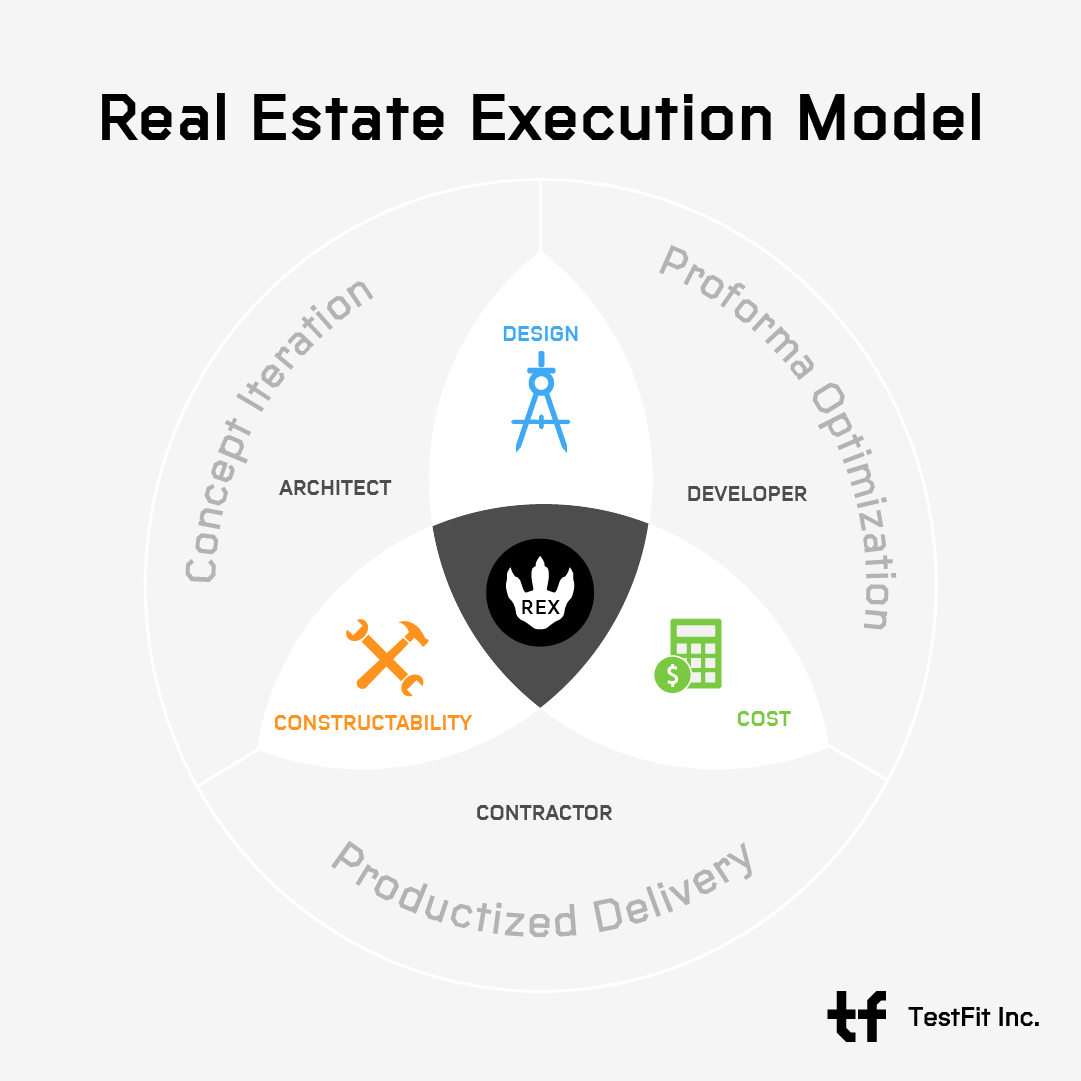
The Real Estate Execution (REX) Model
The REX model is a software system focused on cost, constructability, and design. The basic goal of REX is to meaningfully combine proforma, pricing, and building design into one model, so deal teams can work more effectively. Delivering coordinated documents with millions of model elements can wait until after the big decisions are fleshed out.
Real estate feasibility has grown to consume vast amounts of corporate resources. Regulations are up, funding sources are difficult to identify, pricing has vast volatility, and managing all of this information is getting in the way of real estate development happening.
The REX model will enable real estate deal teams — the architects, developers, and general contractors — to collaborate instantly on real estate deals, with the software stack focusing on what questions matter at the outset. Deal teams can collaborate on entire pipelines of projects, codifying joint approaches to solving deals.
Outcomes of Utilizing REX
- Lowering the friction for deals to be assessed means more deals will be considered, with higher quality analysis
- True lifecycle analysis, lowering the friction for DfMA to be used in every deal
- Improved purchasing power for DfMA suppliers
- Improved access to productized markets
- Data to influence change in policies and zoning based on informed economic models
- Frictionless, team-based site selection
- Acceleration of good real estate deals into schematic design or design development
It Takes an Ecosystem
To bridge design tech, contech, and proptech with the most comprehensive feasibility tool possible, we are endeavoring to build "Real Estate Execution Modeling." TestFit will be working with our customers, other companies, and industry stakeholders to refine REX so users can deliver better outcomes. We believe that by integrating pro-forma, costing, and design, the REX model will lead to significant productivity improvements within the commodity industry, changing how the real estate industry collaborates.
Today's News
We'd like to announce the closing of TestFit Inc's $20M Series A led by Parkway Venture Capital to build our vision of REX and to serve our customers more effectively. We are hiring.