At TestFit, our greatest passion is the meaningful creation of buildings — specifically, the kinds of buildings that typical human beings use on a regular basis. We are driven to improve the quality and quantity of commodity architecture. We are disrupting the building feasibility process in the housing, hotel, office, retail, parking, and multifamily industries, and ultimately aim to assist in ending the worldwide housing crisis.
Some Context
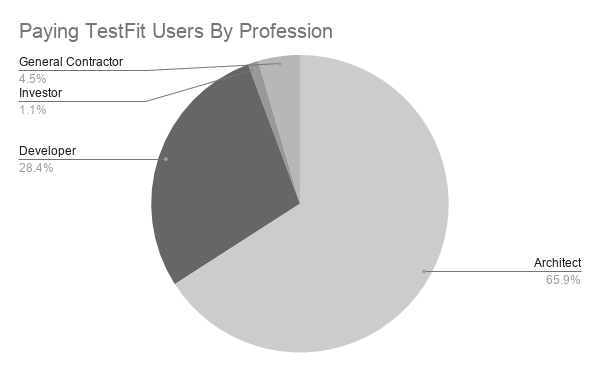
In my capacity as Co-Founder and CEO at TestFit Inc I oversee the creation of algorithms that design buildings. We automate feasibility studies for commodity buildings. We sell our algorithms in the form of a configurator — essentially "excel" for buildings. We package it in software and sell that software to architects, real estate developers, investors, and general contractors. You will notice that 2/3 of our users are architects. That's right: we sell practical automation tools to architects.
A Brief and Grossly Over-Simplified History of Automation
Cities only exist because a hunter-gatherer decided they had had enough of hunter-gathering and the modern industry of agriculture was born over 8000 years ago. Those early innovators found that tilling soil was back-breaking work, so they automated it by domesticating large animals that could till soil easily. Fast forward to the 21st century: GPS-enabled combines do all of that work autonomously and architects are still using trace paper.
The digital mechanization of the architecture industry started in the 1980s. It's been happening for 40 years, longer if you include mechanical mechanization (looking at you parallel bars, compasses, protractors, and scales). Given the amazing propensity of human innovation, automation is inevitable. It is also true that machines are really bad at doing anything without human direction or intervention.
So, what is the litmus test for whether or not a particular automation should exist? I credit this line of thinking to Travis Connors (Co-Founder at Building Ventures):
If a machine can do it better than a human, a human will never do it again.
One hilarious example of this is Juicero, which raised $140M from Silicon Valley to make a juice press that was less effective than a human squeezing juice with their hands.
The opposite of this is the prevalence of mapping technologies. When was the last time you actually gave someone directions? Just drop a pin. Humans suck at giving directions and following them. Do you know what follows directions perfectly and executes the same exact way every single time? Algorithms.
Doing the Hard Work of Building the Constraint Engine
In March 2018, Bill Allen of Evolve Lab invited me to write a guest post on their blog. I titled it "Let's Face It. Connecting Nodes Sucks". It walks through some of the early algorithms we built to create our minimum viable product Residential Engine. We reasoned that in order to have an accurate building to then do optimization on, life safety must be taken into account.
We felt the tool must provide real data that confirms our users' planning assumptions to materially provide real value to them. An allowance needs to be made for setbacks. Unit mix and balcony assumptions cannot be ignored as they affect the mass placement and the parking demand. In the real world, buildings are an amalgamation of thousands of parameters, and most "generative design" tools have tens of parameters, are often site-specific and completely un-reusable. By comparison, our most powerful algorithm in late 2020 has a whopping 150 parameters revealed to the user.
A Quick Anecdote About Fear
At one TestFit presentation in Atlanta in late 2017, an architect suddenly stood up and started muttering that he should learn how to be a poet because everything sacred was going to be destroyed by millennials and their computers. We were new and un-tested. We had no co-creation tools, and freaked out many people in the planning world. TestFit is viewed by many in architecture as a threat. It's not unreasonable — humans always resist unknown change.
We acknowledge this fear. If there is only one voice on "Generative Design" it will assuredly get implemented for the aims of that voice. One could sell an algorithm for $100k to developers to have exclusive access to some kind of black box "optimizer." I've led 865 external client meetings in the last three years, and can guarantee that it is much wiser to build a product that has had thousands of architects, developers, and general contractors use, weigh in on, and provide feedback to. Iron sharpens iron, and our future roadmap doesn't lead to black box. It leads to a very sharp co-creation ecosystem.
Our Promise to Architects: It's Co-Creation, not Desolation
If we don't continue to introduce manual editing and manipulation tools, we are no better than a black box. If we don't keep architects' needs central to our mission, our building configurator has no meaningful future or broader impact on the industry. The future of TestFit is not replacing architects — it's making them dramatically faster at the parts of the job that don't require genius.