While in architecture school, in my third design studio, we had a project: design a library of the future. This was in 2011, and everyone set to figuring out how many stacks of shelves they needed to fit into their 4000 SF library. Nobody went to the actual library at Battle Hall to research libraries. We went to the computer lab and googled precedent. That was when it hit me: Architecture will never be the same. Technology will drastically alter not just the built environment but the process of designing and building it. I designed probably my best project in college after this insight: instead of musty stacks, the library of the future would have a book vending machine and everything else would be a computer lab. The project won UTSOA Design Excellence for the best library.
The Impetus to Write this Article
I have been selling software to architects, real estate developers, and general contractors for the last two years. My little startup, TestFit, creates practical generative design tools that anyone can use. It has, in effect, democratized generative design so that anyone who wants to use it can click 7 buttons and have a meaningful building generated. To date I have given well over 700 live demonstrations of our software to AEC industry stakeholders. In this time we have closed close to 12% of those demos into paying customers. The other 88% always have something wrong with the software for them or their company to adopt it. This is fine — this is a typical sales process. We win few and lose most.
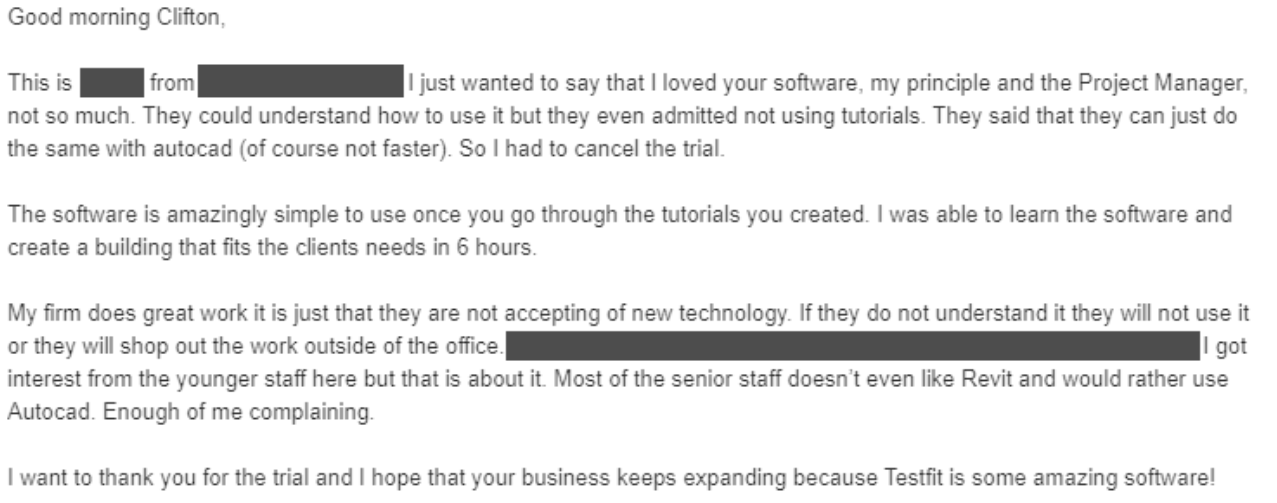
Here is the rage-inducing part in several failed sales: we have perfect product-market fit, a perfect demo, a perfect free trial, a willing-and-able user — and some decision maker kills off the entire thing because new technology is: (pick one) scary / going to take all of our jobs / we can accomplish the same thing with CAD / I can do this on trace paper / I am unwilling to understand it / this isn't an Autodesk product / we don't have time to train people / any number of other things.
Why I Quit Architecture
I have over 5500 hours of IPD completed (AXP now). I put in at least 2.5 years of professional effort to become an Architect. I was deeply invested. I have a 5-year professional Bachelor of Architecture from The University of Texas at Austin — which is consistently ranked in the top 10 every year. I killed myself in studio for ten semesters.
I started studying for the AREs. But this is when I realized that I wanted to quit.
Major Lack of Creative Problem Solving
The first time I remember being flabbergasted with architecture was at one of my first internships. I was told to manually change over 1200 doors from A to B in a door schedule in AutoCAD. After manually changing the first 15, I googled how to find and replace in AutoCAD. I saved the file, did a find and replace, and boom — done. My supervisor sent me home early that day. I was penalized as an hourly worker for being efficient.
I asked for a Lynda.com subscription to learn how to use Revit — it was denied because I wasn't critical to the firm's process. I bought my own subscription and later that internship I gave an internal lunch-and-learn on how to use Revit. I attempted to implement blocks in AutoCAD at another firm. If you wanted a door tag, it was an oval with a text box. If you wanted to draw a door? It was four lines and an arc. I asked if I could create a door block and was denied. Annotative scales? No way. Batch plot? Never heard of it. Lisp routine to clean files? Absolutely not.
All of this was annoying, but process-related. I was always designing well-crafted buildings — the product was awesome. I also had really amazing coworkers. An internship at Overland Partners was the best, most exciting work experience I ever had — and it was only 3 months.
How You Can Keep Millennial Talent
If you are a firm leader and read through my list of "complaints," you might be thinking I'm just another self-entitled millennial. I'm fine with that as long as you read this next part.
There are three parts to your business:
- Product — the buildings that get designed and built.
- People — the leadership, middle management, draftsmen, consultants, and clients.
- Process — where the rubber of people meets the road of product. If you have the first two in good shape, this last bucket is where you can keep your talent.
Have you asked the millennial cohort how they would improve process? We are wired completely differently — born into the digital age. I have never known a design world without Google Earth, Sketchup, or BIM. Things like "we are a Revit company" will become incompatible with third-generation design tools, where moving and manipulating data is far more important to your survival as a firm than your people or your product.
The Future of Architecture
This hit me in two separate instances. First, during my work with Ryan Griege at TestFit. He is a brilliant software engineer and all he needed me to do was describe a procedure for designing multifamily buildings, parking structures, or self-storage buildings. He took these ideas and built the most powerful configurator on the market today.
The second instance was through my discussions with Ian Keough, the father of Dynamo. His startup company, Hypar, is a platform to capture and deploy AEC expertise. In the future there will be a Perkins + Will core and shell configurator algorithm pushing data into a Gensler office interiors algorithm, that result will be sent to a Thornton Tomasetti structural algorithm coordinating with a BuroHappold mechanical systems algorithm that has been optimized by a Cove.Tool energy analysis.
What is left for architects? That 10% of the building that is beautiful, meaningful, contextual, spiritual, and ultimately crafted — not to mention the algorithms you will be writing with software engineers. Keep millennials around by investing in their future.
There is Major Cause for Alarm
My goal here is to be alarmist. To jolt some of the John Doe AIAs into action. Stop doing everything the same way. In software development, if we have to do it more than twice, we automate it. If you will not move right now, your best talent will quit with all the knowledge you did invest in them, and even worse they will quit with all the knowledge you did not invest in them. They will take it somewhere else. They might build a 21st-century firm that will beat you. Real estate developers and general contractors are already vertically integrating everything — they pay their employees better, give them better resources, and far more freedom to innovate.